
Newsletter 001 (Q2/2023)
Conner Automation Business News
Welcome to the first newsletter for Conner Automation Inc. In this newsletter, we will attempt to convey topics of interest, industry news, and company updates for our clients. The newsletter will be structured with the following columns, and there are already topics lined up for the next couple of issues:
Trending – Here, a newsworthy topic of interest will be covered in a timely manner. It may be an emerging technology, a noteworthy trend in the industry, or simply a new fad. Potential to impact the process automation industry will be discussed.
Main Focus – A main focus topic will be covered more in-depth. These may be conference reports, product reviews, or an in-depth review of a particular service or technology. Often, practical applications may be highlighted in Main Focus topics.
SideNotes – The SideNotes column is an opportunity to brainstorm. This column will generally be written more freeform, as a train of thought. This is an opportunity to really just think out loud (on paper).
Conner Automation Business News – Just as it says, this column covers news relating to Conner Automation Inc. Activities we are involved in, what’s happening from a company/business perspective, or other topics to be communicated to clients may be posted here.
Note that Conner Automation, Inc has no sponsorships at this time, and these are not paid reviews of products or services. The Newsletter is really just an opportunity to inform potential clients around a variety of topics of interest, and does not represent sales or advertising material.
With that, I hope you enjoy reading through the first issue of the Newsletter. Future editions should be available quarterly.
Trending
The Rise of ChatGPT
If you haven’t heard of ChatGPT yet, chances are you soon will. Chatbots have been part of our daily life for over a decade, and we all have a love/hate relationship with Alexa, Siri, and Google Assistant. It is these daily interactions that likely define our view of AI-enabled chat tools. ChatGPT is different. It is trained on a vastly wider knowledge base and dataset than any of these other tools with which we are familiar. GPT stands for “Generalized Pre-Trained Transformer”, and herein lies one weakness: ChatGPT is Pre-trained. i.e. it is not aware of current events. But, for any events prior to the training period through the year 2021, it is knowledgeable … really knowledgeable! This chatbot is already being banned in schools due to its amazing ability to write entire essays that are factually accurate, express opinions, and well-formed defenses of the main thesis. Want a 500 word essay on the Egyptian Pharoah Khufu? Just ask, and ChatGPT will generate it!
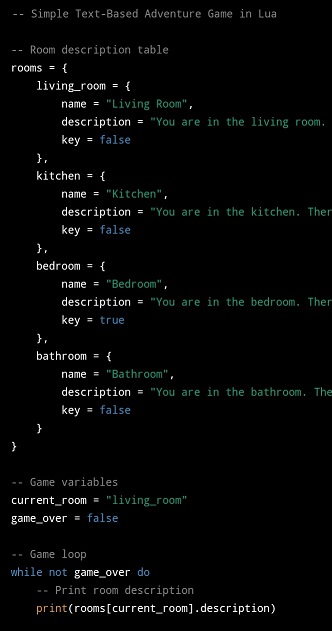
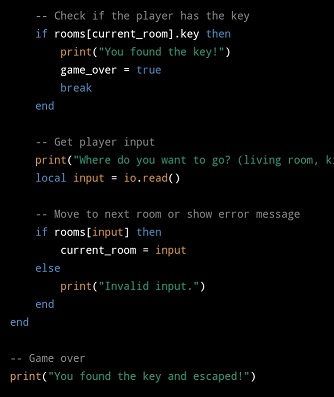
How will ChatGPT affect our industry? It turns out the chatbot is particularly good at writing code, as syntax rules are fairly simple to figure out as far as languages go. Try asking ChatGPT to write a simple adventure game in C++, and you’ll get commented code with well-formed data structures for your inventory, a system of rooms, and a parser for commands. Want it in another language? Just ask (I had this example converted to Lua in just a few seconds). Even more amazingly, the bot can find different solutions to the question posed, rather than simply repeating the same answer every time.
So, ChatGPT could be an excellent resource for certain scripting applications that we find in HMIs or SCADAs. It doesn’t do so well if you ask about very specific details of, say hardware configuration in DeltaV. You’ll get an answer, but it may reference configuration tools that don’t even exist. So, rest easy (for now) Automation Engineers, ChatGPT isn’t taking your job yet, and you may even find it to be quite helpful when you need an example of some particular syntax, or to clear writer’s block.
In just a few months, this chatbot has risen from virtually unknown to take the internet by storm. You can find endless examples of uncannily accurate conversations, and also just plain wrong information generated by ChatGPT. Maybe we’ll do a Main Focus story on it in this newsletter someday, as I am sure the minds over at OpenAI are already working on the next generation of improvements. Or maybe ChatGPT is already improving itself!
Main Focus
The Opto22 Groov RIO
First things first – this is not a paid advertisement for Opto22, but rather a review of the features and applications for which it may be relevant. There are undoubtedly more features and applications than I could possibly cover in this brief Main Focus topic, but I will try and highlight what I find most appealing about this novel piece of tech.
The Opto22 Groov RIO is part of a line of PLCs and Remote I/O cards marketed by Opto22. The Epic PLC line and the RIO remote I/O line offer the latest in communications protocols and industrial IOT connectivity. It is a 10 channel device (8 configurable I/O + 2 relay outputs) that supports Modbus TCP, OPC-UA, MQTT, and various other integrations through Node-RED. The groov RIO can even run an Ignition Edge instance right on the card, allowing easy integration with an Ignition system. Note that an additional license is required for the Ignition service. The 8+2 I/O points are easily wired to the front of the card with the connector and tool provided. The front of the card is shown in Figure 1.
Power may be provided by either +24VDC, or conveniently Power over Ethernet (PoE). I found the PoE option extremely useful for a test setup, as I didn’t need to worry about wiring up a power supply at my desk, and I suspect your Health and Safety people will feel the same.
Each channel is configurable as an Input or Output, voltage, current, or discrete (with a few exceptions). Opto22 has conveniently provided wiring diagrams to show how each channel should be wired depending on the configuration, using the internal circuitry as required to read or write the relevant signals. The documentation is all inside the configuration web application. A couple examples for voltage and current inputs are shown in Figure 2. These are clear and easy to decipher, even if you aren’t in Instrumentation.
To configure the Groov RIO, you use a web client to access the web server hosted on the card. In your web browser, you go to the IP address of the card (which can be found using an application provided by Opto22) and create a login for yourself and any additional configurors. After login, you are taken to the Home screen (Figure 3).

Figure 1. Opto 22 Groov RIO Front

Figure 2. Wiring Diagrams Included
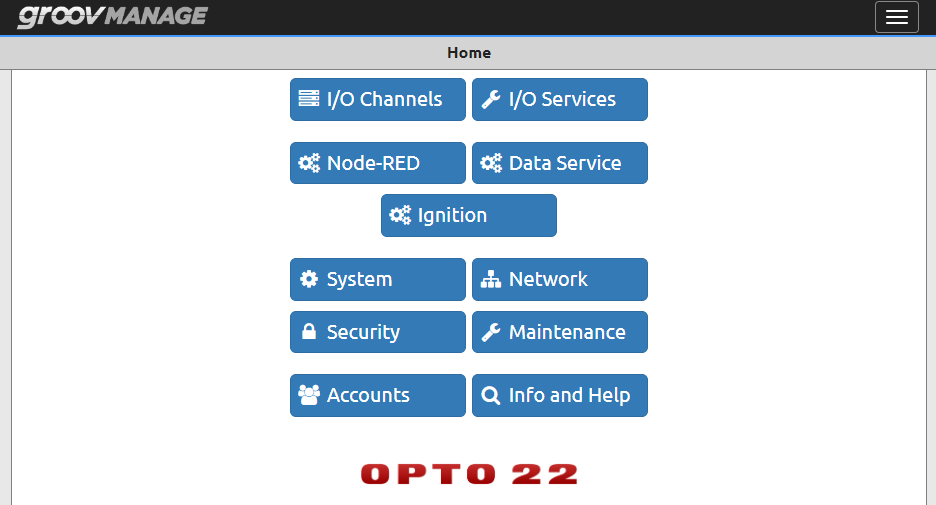
Figure 3. Groov RIO Home Screen

Figure 4. Groov RIO Data Service Screen
From here, you can configure I/O channels, edit network details, manage users, enter the data service, and access the Node-RED and Ignition applications. The Data Service configuration screen is shown in Figure 4.
Here, you can configure settings for MQTT and OPC UA. If you are not familiar with MQTT, it is a protocol that is rising in popularity for IoT applications, and can be conveniently integrated with a number of cloud services. The Groov RIO can utilize traditional MQTT style messaging, or adhere to the Sparkplug B standard which is being developed for industrial process control applications. For more information on MQTT Sparkplug B see the whitepaper published by Opto22, or various other vendors offering MQTT brokers supporting the Sparkplug B standard.
Incredibly, this card also has the ability to run up to 4 PID loops right on the I/O card! Yes, this means you can directly link an input channel to an output channel with a PID loop … no PLC required! In fact, you can do this for multiple loops running on the same card. The setpoint is configurable as an external Modbus register to be written to. What’s more, with the power of the Node RED engine and MQTT, you can actually bring in external signals and use them in your control loops. There are undoubtedly more ways to configure this than I could try out or explain in this article, but please check out the documentation from Opto22 to see all the card has to offer. This is truly a game changer for small applications requiring simple data collection and no-frills PID applications. I’ve included some screenshots of the PID loop configuration screen (Figure 5) and the PID trending and tuning screen (Figure 6). Note the ability to choose algorithms, clamp outputs, set default outputs, and use feed forward if required. You can enable external read access to the PID registers over OPC UA by enabling the “Public Access” option.
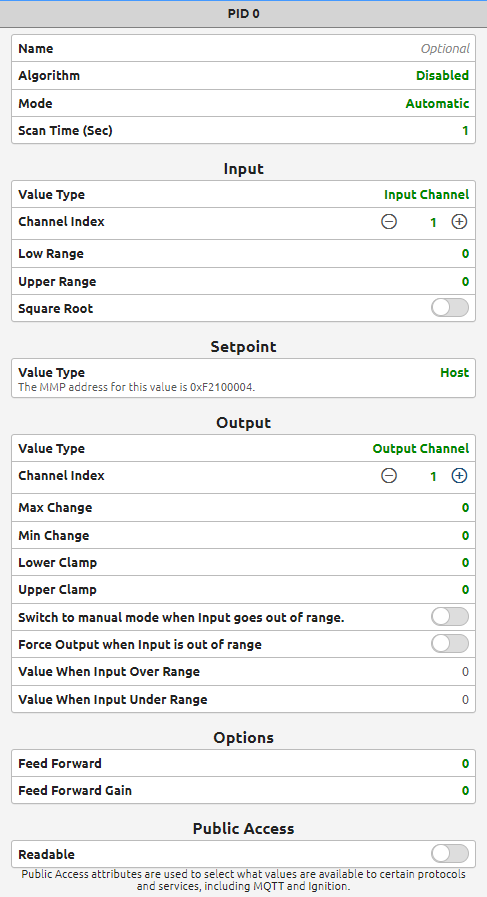
Figure 5. PID Configuration Screen
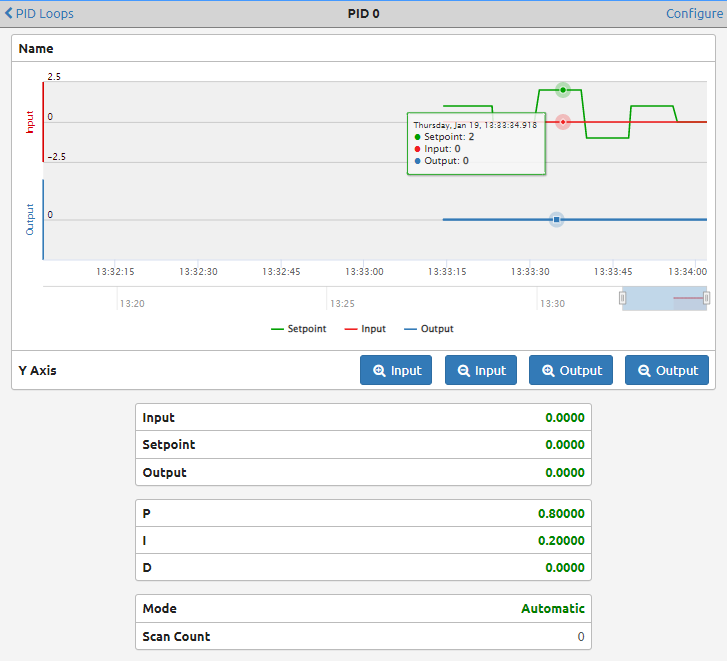
Figure 6. PID Trending and Tuning Screen
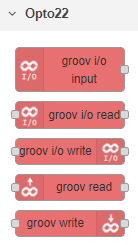
Figure 7. Opto22 I/O Node RED Interface
A really cool feature of the Groov RIO is the ability to configure workflows in Node RED. Admittedly, I am no expert in Node RED (put it on the ToDo list!), but simply put, it is a function block diagram (FBD)-based programming language. A wide variety of blocks are available either out-of-the box, or by downloading external packages from community contributors. I would definitely consider this for prototype or development applications, but perhaps hold off on production applications until a validation strategy is in place.
Inputs from the Groov RIO card itself, as well as external inputs transmitted over MQTT or a web API may be brought in to the workflows (Figures 7 and 8). These features are very unusual to see in legacy control systems, and often additional application servers are necessary to interface with these types of signals. The Groov RIO is truly built for IIOT development!
Simple mathematical operations, complex scripting operations, or other manipulations may be made using the various function blocks available. Consider the simple workflow demonstrated in Figure 9. Here, you can imagine one of the available analog channels from the Groov RIO being combined with an external signal from an MQTT broker. The signals are combined into a single packet and then retransmitted over MQTT. Perhaps another system picks up this aggregate and sends data to a historian or alarm system for further processing. Of course, additional logic could have been included in the Node RED workflow, but in this simple example, it is assumed the only requirement is the addition of the analog signal to an existing MQTT packet. By now, hopefully you can see the possibilities opened by these capabilities in such a small, compact I/O card!
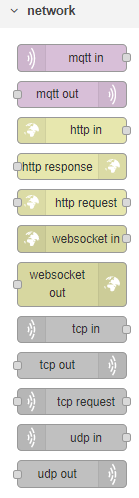
Figure 8. Node RED External Network Interfaces
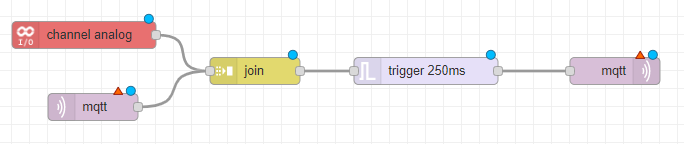
Figure 9. Example Node RED Configuration
There are additional features that I couldn’t cover in this article, but I hope to have touched on what excites me the most about the Groov RIO. For example, the capability to run Ignition Edge on the I/O card itself could prove valuable to anyone who has an Ignition-based infrastructure up and running. The configurability of the 8 different I/O channels and two relay outputs offer a lot of options for small applications. And, of course, the Groov RIO can be integrated into larger DCS and SCADA systems using the communications protocols available.
In summary, Opto22 has brought to market a potential game changer for simple automation applications where there is a need to run simple PID logic on the device, or where IIOT connectivity is required. I am excited about the possibilities this remote I/O card has to offer, and I am very interested to see it used in various applications.
SideNotes
Is Wonderware Still Relevant?
A contact of mine recently reached out to me to ask whether I can work with Wonderware. My initial reaction was in the affirmative, as I have personal experience with Wonderware based systems in the past, ranging from the Archestra system on a particular single-use bioreactor HMI to particulate measurement devices for industrial syringe and vial filling lines. But that was some time ago, and I couldn’t help but think – Is Wonderware Still Relevant? So, to brush up a bit, I did some quick searching and found that the platform is now owned by Aveva Group since early 2014. Aveva has taken to modernization of the platform and has a product called the “Aveva System Platform,” with the tried-and-true Wonderware as the SCADA component. The familiar components of Archestra and Galaxy databases are still intact and taking new life in the platform.
So, YES. Wonderware is alive and well. In addition to the thousands of legacy applications out there, new applications are being developed on the Aveva System Platform.